
Carmine Bee-Eaters of South Luangwa: When and Where to See Them
A Brightpath Travel Guide
For a few weeks every year, the riverbanks of South Luangwa turn into something that looks almost unreal — thousands of Southern Carmine Bee-eaters, their plumage a blaze of pink, crimson, and turquoise, streaming in and out of nest burrows carved into the cliffs above the Luangwa River. It’s one of the most visually spectacular wildlife events in Southern Africa, and one of the most overlooked by travelers who don’t know exactly when to time their visit.
This guide covers what the phenomenon actually is, when to see it, where along the river it happens, and how to experience it well — whether you’re a dedicated birder, a photographer, or simply someone who wants to witness it firsthand.
What’s Actually Happening
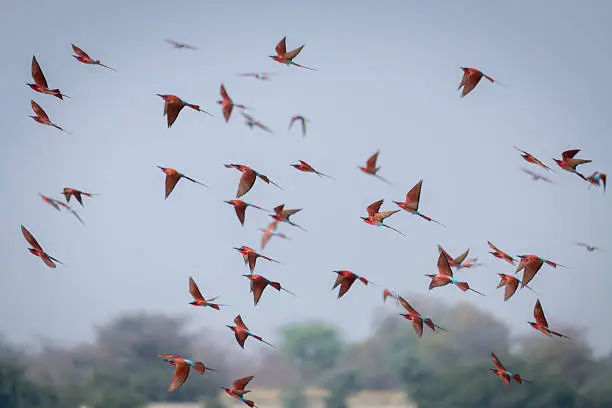
Southern Carmine Bee-eaters are intra-African migrants — birds that don’t cross continents, but move within Africa itself, following the seasons. Each year, as South Luangwa’s dry season sets in, they arrive from further north and south in enormous numbers to select breeding sites along the river’s steep, exposed banks.
What makes the spectacle so striking isn’t just the birds’ color — it’s the scale. Colonies can number in the hundreds to thousands at a single site, all nesting within the same short stretch of riverbank, creating a constant, shimmering motion of birds launching, hunting insects on the wing, and returning to their burrows. It’s as much an auditory experience as a visual one — the volume and movement of a colony this size is unlike anything else on a typical game drive.
When to See Them
The Carmine Bee-eaters’ breeding season in South Luangwa runs roughly from August through mid-October, with the colonies at their most active and densely populated from September into early October.
Outside this window, the birds aren’t present in these numbers — this is genuinely a “right place, right time” experience, not something you can reliably catch on a general visit at any point in the year.
Where Along the River
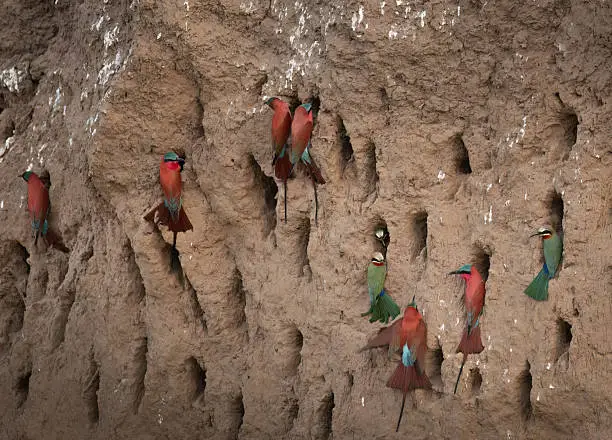
Carmine Bee-eater colonies appear at multiple points along the Luangwa River’s steep banks, rather than at a single fixed location — the birds select suitable nesting cliffs each season, and several camps along the river have colonies nesting directly in view of, or a short drive from, their properties. This is part of what makes South Luangwa such a reliable destination for the phenomenon: the right riverbank habitat is widespread throughout the park, not confined to one small area.
How to Experience It Well
Consider two separate viewings at different times of day — dawn and dusk light change the colony’s activity and the photography conditions considerably, and each offers a genuinely different experience of the same colony
A Note for Photographers

The sheer density and motion of a Carmine Bee-eater colony makes for one of the more technically rewarding wildlife photography subjects in Southern Africa — fast, colourful, and set against dramatic riverbank cliffs. A longer zoom lens rewards you here, and a stationary position (a hide, or a quiet moment on a walking safari) often outperforms a moving vehicle for getting a clean, sharp shot of birds in flight.
Plan Your Visit
Ready to see it for yourself? We run two ways to experience the Carmine Bee-eater season, depending on what you’re after:
5-Day South Luangwa Carmine Bee-Eater Safari → — A 5-day, fully inclusive fly-in safari built specifically around this season, staying riverside at Track and Trail River Camp.
8-Day South Luangwa Photographic Safari → — For travelers who want to go deeper on the photography side, across two South Luangwa sectors, open to photographers of every skill level.
Looking to explore South Luangwa more broadly, outside this specific season? See our full South Luangwa National Park Guide →.
Are Carmine Bee-eater sightings guaranteed?
No sighting in the wild is ever 100% guaranteed, but during peak season (September–early October), the colonies are large, active, and reliably present — this is one of the more dependable wildlife spectacles in the region within its window.
Do I need to be a birder to appreciate this?
Not at all. The scale and colour of the colonies make this a genuinely striking experience for any traveler, not just dedicated birdwatchers.
Can this be combined with general game viewing?
Yes — South Luangwa’s renowned predator activity, elephants, hippos, and general game viewing continue as normal throughout the bee-eater season, so this isn’t a trade-off against a typical safari experience.
What’s the best time of day to see them?
Dawn and dusk tend to offer the most activity, when temperatures are cooler and the birds are most active around the colony.
All trip content is fully customisable to your dates, group size, and interests — get in touch and we’ll help you plan around the Carmine Bee-eater season.